If you are looking for a Wiki.js alternative, the question is usually not whether Wiki.js is good.
It is.
The more useful question is whether it matches the kind of documentation setup your team actually wants to run.
For a lot of small teams, internal documentation starts with a simple need: runbooks, onboarding notes, product documentation, technical guides, and a place to keep knowledge organized over time. What often comes later is the realization that the wiki itself has become another system to operate.
That is the gap LeafWiki is trying to address.
Why teams look for a Wiki.js alternative
Wiki.js is polished, capable, and well known in the self-hosted world. It also covers a fairly broad surface area.
For some teams, that is exactly the right tradeoff.
For others, especially smaller teams, it can feel like more platform than they actually wanted to own just to maintain documentation.
LeafWiki comes from a simpler idea: if the main job is documentation, the tool should stay focused on that job.
The practical difference
Wiki.js is a broader documentation platform.
LeafWiki is a smaller, more focused wiki for teams that want something easier to run and easier to reason about over time.
That difference shows up in a few places.
The stack. Wiki.js typically means Node.js plus Postgres. That is a normal stack, but it is still a stack you need to run, update, back up, and think about. LeafWiki is a single Go binary with SQLite, so the operational model is simpler.
The scope. Wiki.js covers a wider feature surface. LeafWiki is intentionally narrower. The goal is not to compete on breadth. The goal is to make structured documentation straightforward without turning it into a larger platform than necessary.
The content model. LeafWiki is built around tree-based documentation. That works well for runbooks, internal guides, product docs, onboarding material, and technical notes where hierarchy is useful. Not every team wants that, but for teams that think in sections and parent-child structure, it can be a better fit than a flatter collection of pages.
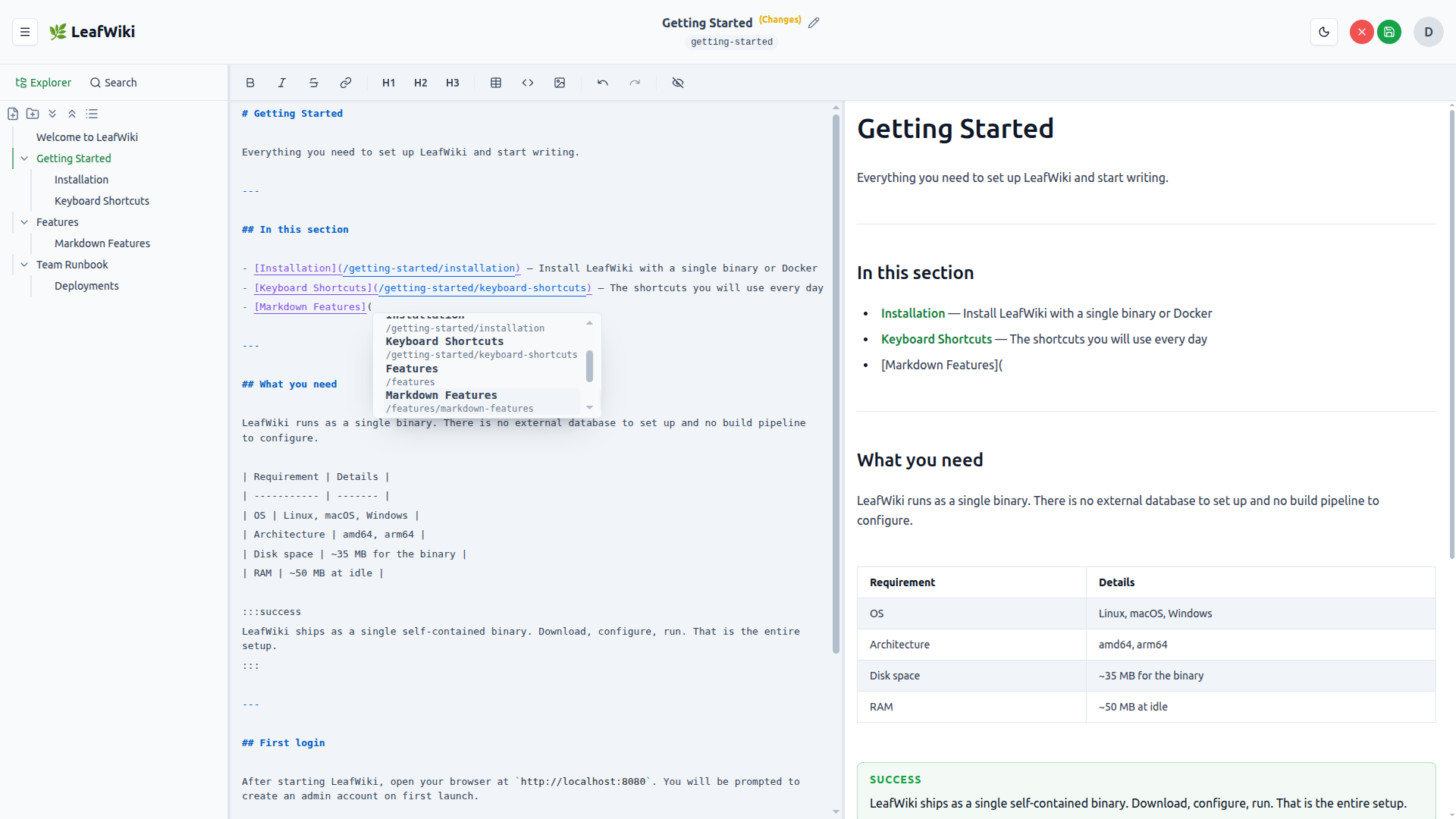
The writing flow. LeafWiki is shaped around day-to-day documentation work: live preview, internal link autocomplete, image paste, search and replace, backlinks, and revision history. The point is not to have the broadest editing surface. The point is to make routine documentation work feel smoother.
“I’ve been using Wiki.js up until some months ago but it was too much effort to manage assets, sidebar tree, links… here it’s just ‘create page in sidebar → upload assets per page → done’.”
Sergio N., LeafWiki user
Where Wiki.js is the better fit
There are still plenty of cases where Wiki.js is the more obvious choice.
Choose Wiki.js if:
- you want a broader platform with more built-in capability
- you expect more complex requirements around auth, integrations, or administration
- you are comfortable operating a larger application stack
- you want something closer to a full internal documentation platform
That is not a weakness. It is just a different target.
Where LeafWiki makes sense
LeafWiki makes more sense when the problem is narrower and more practical.
Choose LeafWiki if:
- you want a self-hosted wiki that stays easy to operate
- your main use case is structured documentation for a small team
- you prefer Markdown-first workflows
- you want a tree-based knowledge structure rather than a flatter workspace feel
- you want the wiki to remain focused instead of gradually becoming another large internal tool
Personally, that is the use case I kept coming back to: not “what is the most powerful wiki I can run?” but “what is the simplest wiki I would still be happy to use and maintain a few years from now?”
That is the angle LeafWiki is built from.
A smaller tool can be the better fit
For some teams, Wiki.js is the right answer.
But if you are searching for a Wiki.js alternative, there is a good chance the issue is not features. The issue is fit.
If what you want is a maintainable internal wiki focused on documentation, LeafWiki may be a better match simply because it tries to do less, on purpose.
Try the LeafWiki demo or check the GitHub repo.
If you find LeafWiki useful, consider sponsoring the project, it helps keep development going.